Design of Bike in a Pyramid
(aka Bykamid)

(Artistic cutaway view)
The pyramid size (ie the square base, but also the ridges to the peak) is 8’ for a few reasons:
|
• wood comes (most easily) in 8’ lengths; • if it was smaller a bike wouldn't fit; • if it was bigger it would start to get heavy; • if it was bigger it would more difficult to transport; • screen door mesh is just the right size; • it matches the living quarters cube size; |
There will be 4 pyramids, one for each of: Bryan, Emily, Sarah, and Chris.
Each pyramid is pre-made with 4 triangles using 1"x1"x8’ pieces of wood.
Each triangle is covered in screen-door flyscreen mesh,
which can be bought in 7’x4’ pieces.
When cut diagonally (an 8’ 1" length),
the two pieces can be positioned as one triangle
perfectly (or a little over - which is good for) fitting
the triangle.
It is likely the join in the two meshes will need to be sewn,
but this seems like it will be too difficult,
so I believe it is easier to have a wooden slat from the top
to the base/side, to attach the mesh to.
That slat will also provide support of the mesh over the
expanse of the triangle.
Assembly
Three triangles (rear, right side, and front) are fitted together,
each with 2 bolts holding to the next triangle (4 bolts in total),
but there is also a piece of wood connecting the front and rear
triangles on the left, along the base of the pyramid.
The 4th triangle (left side) is attached with two hinges to the rear
to open outwards, and clipped (or hooked) to the front triangle,
when closed. ie a door.
This door was chosen to be on the left as riders usually mount
a bicycle by lifting their right leg.
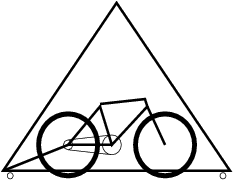 The square base of the pyramid will have a small caster attached
on each corner (see the small circles on the picture to the right).
The (pre-attached) caster and can rotate a full 360°.
See examples.
The square base of the pyramid will have a small caster attached
on each corner (see the small circles on the picture to the right).
The (pre-attached) caster and can rotate a full 360°.
See examples.
The wooden sides should be able keep their straightness
without drooping over the 8’ span due to the
wooden slat for the mesh support.
The measurements of the largest bicycle we have, has a 27" wheel, with a frame size 41" from front to rear axle, and was used in a drafting program, as seen to the right. There is still a few inches between the wheels and the inside of the pyramid.
The bicycle will be attached to the rear base of the triangle
by a piece of metal bolted to the rear axle (left side) of
the bicycle.
The metal will either be flat with a hole at either end
to attach to the bike, and to bolt to the rear triangle,
or could be angle iron. The sturdier the better.
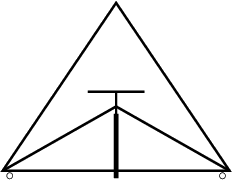 But a rear attachment will not be enough, as it will be needed
for the bike to stay held securely vertical, when nobody is inside.
So to both side base pieces of wood each will have a piece of metal
to go to the front steering stem held with a
hose-clamp
holding both pieces to the bike.
When attaching these pieces of metal, keep in mind they need
to be positioned to avoid conflicts with the riders leg when
in the position required for pedalling.
But a rear attachment will not be enough, as it will be needed
for the bike to stay held securely vertical, when nobody is inside.
So to both side base pieces of wood each will have a piece of metal
to go to the front steering stem held with a
hose-clamp
holding both pieces to the bike.
When attaching these pieces of metal, keep in mind they need
to be positioned to avoid conflicts with the riders leg when
in the position required for pedalling.
The widest handlebar of all the bikes is 25" wide,
which is what has been drawn in the picture to the left.
Actually the largest bike does not have the widest handlebar,
so there are no issues of the handlebars of any bike hitting
the insides of the pyramid.

Illumination
Half of the experience of BurningMan is nighttime.
Vehicles are illuminated in one way or another,
either for safety (to not get hit by others who didn't see you)
or just to look good.
The plan is to use
yellow LEDs
mounted on each triangle, doing a chase pattern:

 |
For each side (and there are 3 sides to a triangle),
with 12v, and a 0.7v drop over a switching transistor,
and LEDs being rated as 2.1v/10mA,
5 LEDs in series would be 11.2v, which is too close to
the 12v (considering batteries lose voltage as they discharge)
so 4 LEDs (in series) add up to 9.1v, which is good,
would need a current setting resistor over the remaining 2.9v.
That's 2.9/0.01 = 290 ohms,
and 2.9*0.01 = 29mW.
Over the entire pyramid that's 120mA and 348mW - not much power loss
due to heating a resistor, but a constant current circuit do drive
the LEDs would be nice, but that could get complex.
Over an 8 hour night, that's near enough 1Ah, but I could imagine it would be turned off for some of the night.
Using 8 alkaline D-cells (which reportedly contain 14-16Ah) to get 12v,
they would (in theory) be able to run for 14-16 nights,
but due to voltage loss it is reported that a battery
generally can only put out about 2/3 of its rating.
That'd be about 10 nights (constantly on for 8 hours).
More than what we need.
OK, I should:
• test and time the duration of a set of batteries;
• take some spare batteries.
Here is a plot someone did when using 3 D-cell batteries
with a superbright LED (3.4v with 3.2ohms), which starts
out pushing 370mA (3 times what we want), and they let it run:
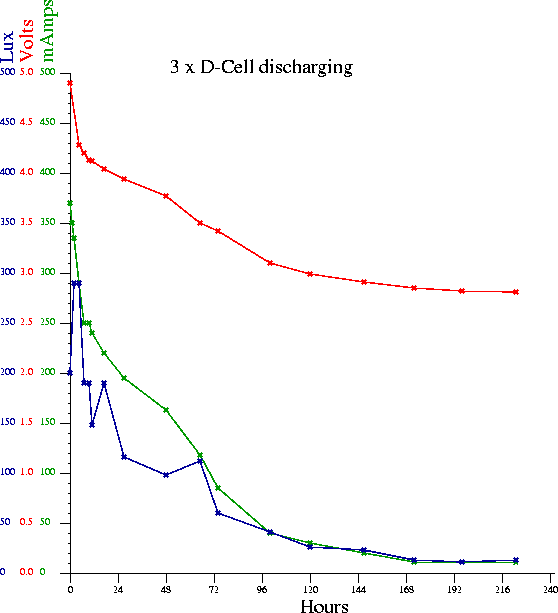
The author of the page
admitted to not taking the best LUX readings.
Looking at the graph, my guess is that LUX (or brightness) is
proportional to the current flowing, and that'd seem to make sense too.
We will be pulling one third of the current,
so the timeline can be multiplied by 3.
Summary: one set of 8 D-cell batteries has PLENTY of power for what we'll need. But that depends on the brand of battery... A school project destermined that while Duracell and Energizer are close and the longest duration of the batteries they tried. About 48 hours. Their test was running a lamp until it went flat. Their Walgreens batteries lasted 33 hours. But I find the cost of Duracells and Energizers are $8 for an 8 pack. Walgreens had a special (8th June) and an 8 pack was $4, AND buy one get one free too! That's 25% of the price, for a batteries that last about 70% of the Duracells, which is close to 3x better from a price per hour point of view.
Looking into a rechargable resource (like a small 12v 7Ah battery), they are more expensive for just the battery, between 3 and 5 times (depending on the brand) of the price of D-cells, harder to come by, heavier (a 7Ah is about 6lbs), and then there's the hassle of recharging somehow. Solar and/or wind recharging would be neat, but a decent solar panel (eg 12v 2A) is expensive, and wind seems to be not particularly generate much power (unless you get a big propeller - which gets expensive). Charging from the car is impractical. Taking a generator to charge batteries is overkill.
Back to the LEDs...
With 4 LEDs per side, and a chase circuit of 1 on/3 off,
as in the above chasing LED image (above),
that's 16 LEDs per side, which would be equally spaced out
over the 8’ at every 5.6".
That adds up to a total of 192 LEDs per pyramid.
To hold the LEDs in place, I believe bending the legs of the LED
into L shapes in opposite direction, and stapling them to the wood,
will work, and be easy to solder to the staples, and the wiring.
 To sequence the LEDs, we need an oscillator,
such as to the right, a standard astable multivibrator
as
documented on the web.
To sequence the LEDs, we need an oscillator,
such as to the right, a standard astable multivibrator
as
documented on the web.
The timing of each side is calculated as 0.7RC.
So using our values:
| • RHS | 0.7 x 10k x 4.7u = 0.0329s | |
| • LHS | (min) | 0.7 x 10k x 4.7u = 0.0329s |
| (max) | 0.7 x 110k x 4.7u = 0.3619s | |
| LHS+RHS | (min) | 0.0658s = 15Hz |
| LHS+RHS | (max) | 0.3948s = 2.5Hz |
This circuit will send its output into a CMOS counter.
Using CMOS is good as the voltage rail can be anything from 3 to 18 volts,
and is very low current, and CMOS outputs can drive upto about 20mA.
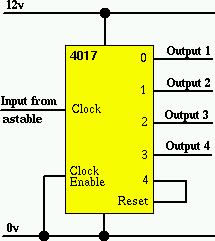 The 4017 CMOS chip provides a sequencing counter (upto 10 outputs),
but putting a reset line on output 4, will mean the counter will go:
The 4017 CMOS chip provides a sequencing counter (upto 10 outputs),
but putting a reset line on output 4, will mean the counter will go:
• 0, 1, 2, 3, then at 4 (for a microsecond - unnoticable to the
human eye) it resets back to 0, and the cycle begins again.
With the output of CMOS going to a transistor with a hFE of about 100,
since a set of 4 LEDs require 10mA to illuminate, the base of the
transistor needs to draw 0.1mA.
So the CMOS output can drive 200 such transistors, we need 12.
Note at 12v, 0.1mA requires a 120k resistor, so using our bulk
order of 10k resistors, that will enable the transistor to flow
about 12 times the current necessary,
ie that will cause no extra resistance there,
not affecting the LED in any way making them dimmer.
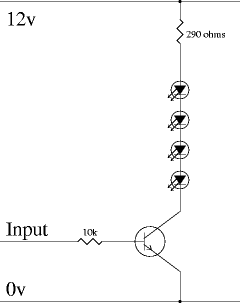 Each of the outputs of the 4017 then can drive a generic
transistor, which will switch on 4 LEDs,
and a current limiting resistor.
Each of the outputs of the 4017 then can drive a generic
transistor, which will switch on 4 LEDs,
and a current limiting resistor.
Each side of a triangle on the pyramid, will have 4 such transistors, resistors, and LEDs. One set for each of the outputs of the 4017.
The circuit needs to be in a reasonably sealed plastic box,
with the variable resistor and power switch fairly accessible.
| bTd home | BurningMan | BurningMan 2003 | Updated: Sat Jun 14 22:38:59 CDT 2003 |